When AI Enters the Workflow, Ownership Has to Become More Explicit
AI does not remove ownership from a workflow. It exposes where ownership was never clear.
TL;DR
A workflow should be diagnosed before AI is added to it. The underlying pressure may call for capacity, process repair, clearer ownership, or automation, and those responses are not interchangeable. AI controls begin with the ownership step by defining information access, review requirements, authority, escalation, and retained evidence. Human review is meaningful only when the reviewer has a standard and the practical authority to intervene. The business remains accountable for actions and commitments made through its workflow.
The diagnosis still comes before the tool
Tuesday’s essay began with a familiar growth problem.
A business feels overloaded. Work is getting done, but the owner is still pulled into approvals. Information moves between people and systems. Employees spend time following up on work that everyone assumed somebody else owned. The team is busy enough that another hire or another tool begins to feel inevitable.
That pressure is real. The diagnosis may still be wrong.
A busy workflow can contain at least four different problems. There may be more necessary work than the current team can reasonably perform. The process may create avoidable work through duplicate entry, unnecessary handoffs, or repeated checking. Ownership may be unclear, causing decisions to wait or return to the owner. Or the work may be sufficiently understood and repeatable to support automation.
Those four conditions do not call for the same answer.
More capacity helps when necessary, well-designed work exceeds the team’s available time. Process repair helps when the workflow itself is creating the load. Ownership clarification helps when people are waiting for authority. Automation helps when the activity, inputs, expected result, exceptions, and responsible owner can be described clearly.
AI does not create a fifth diagnosis. It enters after the business understands the first four.
That distinction matters because a poorly defined workflow does not become clear when an AI tool is added. The tool may prepare an output, but the business must still determine what the work is supposed to accomplish, what information may be used, and who owns the result.
The useful starting point remains the same: trace the work before choosing the investment.
The visible task is rarely the entire workflow
A workflow often appears simpler when it is described as a list of activities.
A customer request arrives. Someone records it. Another person checks it. A manager approves it. The final action is scheduled or sent.
That description captures movement, but it does not capture all the judgment.
Someone decides whether the request is complete. Someone recognizes that an exception matters. Someone knows which customer promise changes the normal rule. Someone decides whether the final action is appropriate. The owner may provide the last approval because the authority has never been assigned elsewhere.
If the workflow is evaluated only at the task level, the business may conclude that several steps are repetitive and should be automated. But the repetition may sit around decisions that remain implicit.
The first useful move is to name the result.
“A complete customer request is approved and scheduled” provides more operating clarity than “manage the inbox.” The first description gives the workflow a finish line. It also makes it possible to ask what must be true before the result is accepted.
Then the business can trace what enters the workflow, how the information changes, where decisions occur, who approves the result, what happens when the normal rule does not apply, and what evidence remains.
That exercise separates activity from responsibility.
Some steps move information. Some protect the quality of the result. Some exist because the current systems do not communicate. Some represent a decision. Some continue only because the business has never decided whether they are still necessary.
The goal is not to remove every human step. The goal is to see the operating logic clearly enough to decide where people and technology belong.
Capacity, process, ownership, and automation remain separate choices
Capacity is appropriate when the work is necessary, the workflow is sound, ownership is clear, and there is still too much work for the available team.
That is a stronger hiring decision because the role begins with understood work. The expected result is visible. The decision rights can be described. The business is adding capacity to a functioning operation rather than asking a new employee to absorb unresolved questions.
Process improvement is appropriate when the workflow creates work that does not protect the result.
Duplicate entry, unnecessary handoffs, unclear intake, and repeated checking can all make a team look understaffed. Hiring into that environment may reduce the immediate pressure while preserving the cause.
Ownership clarification is appropriate when the workflow waits around authority.
The owner may appear to be the bottleneck, but the deeper problem may be that nobody else has a clear boundary within which to act. Employees continue to seek approval because acting without permission feels riskier than waiting.
Automation is appropriate when the work can be described with enough precision to define the normal path, the exceptions, the responsible owner, and the review standard.
These answers can be combined. A process may need repair before part of it is automated. Ownership may need to be clarified before a role can be designed. Automation may remove administrative work while leaving judgment with a person. Additional capacity may still be needed after the workflow improves.
The diagnosis prevents every form of pressure from turning into the same buying decision.
It also prevents AI from being treated as a general answer to an operating question the business has not yet resolved.
Ownership becomes the bridge to AI controls
Ownership is the point where workflow diagnosis becomes AI governance.
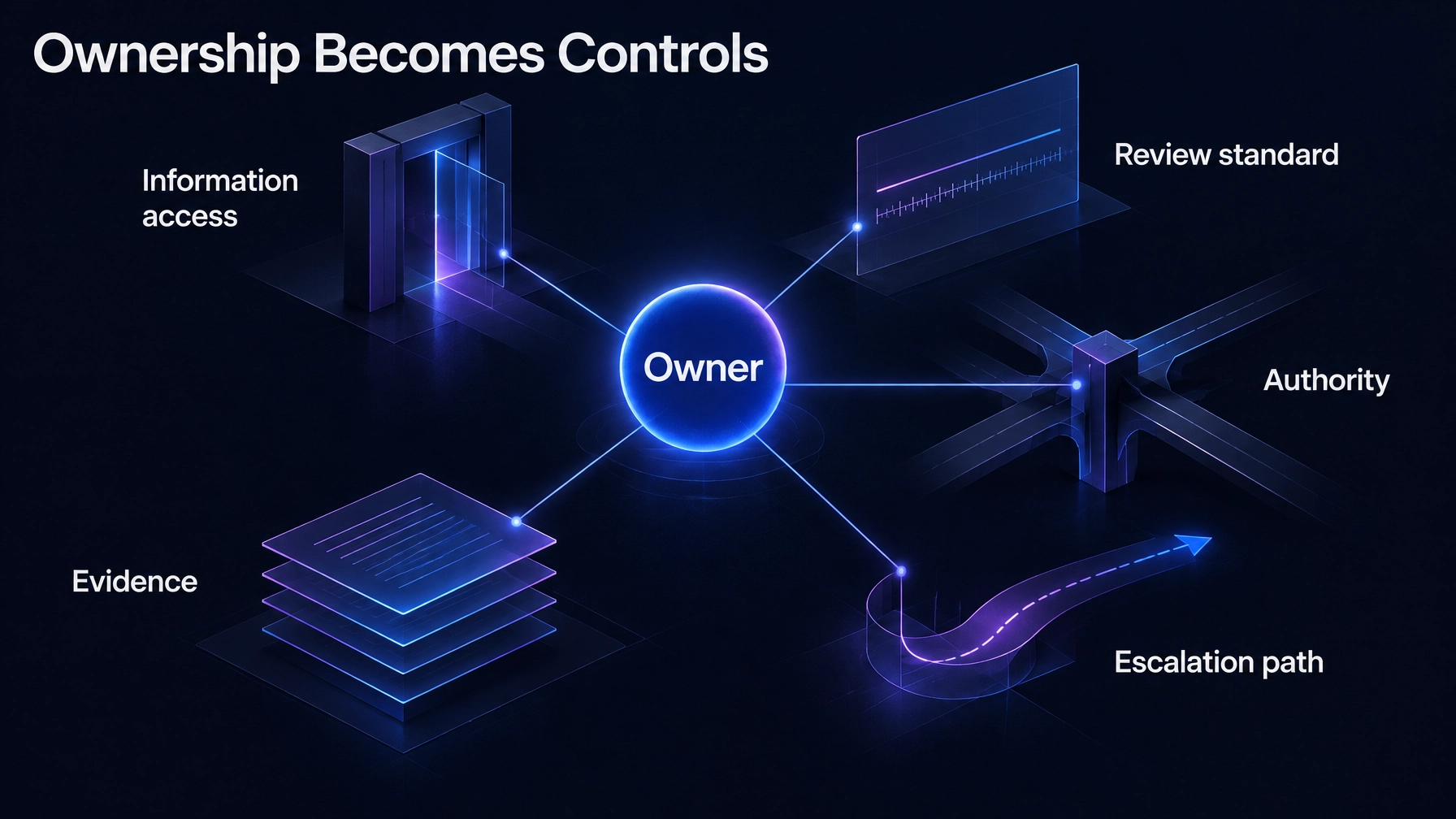
Once the business can name the result, the information involved, and the person accountable for the decision, the controls become more concrete.
What information may the system access?
What output may it produce?
Which output may move forward without review?
What requires approval?
Who can change the instruction, threshold, or permission?
What happens when the expected conditions are not present?
What evidence should remain after the action is complete?
These questions are connected.
Information access determines what enters the work. Review requirements determine whether an output remains a draft or becomes part of the operation. Authority determines whether the reviewer can approve, reject, correct, or escalate. Evidence makes it possible to understand how the outcome was reached.
A generic statement that “a human reviews it” does not resolve those questions.
The reviewer must know what to check. The workflow needs a definition of an acceptable output. The reviewer needs enough information to compare the output with that standard. The person also needs a real opportunity and clear authority to intervene before the action becomes final.
Otherwise, the human review step may be present in the diagram without carrying meaningful responsibility.
The point is not to build the heaviest possible approval process. It is to connect the level of control to the consequence of the action.
An internal outline may remain a draft until a person chooses to use it. A customer message can create a promise. A changed record can affect future decisions. A payment approval moves money. Those workflows should not inherit identical controls simply because each one includes AI.
Assistance and authority are different parts of the workflow
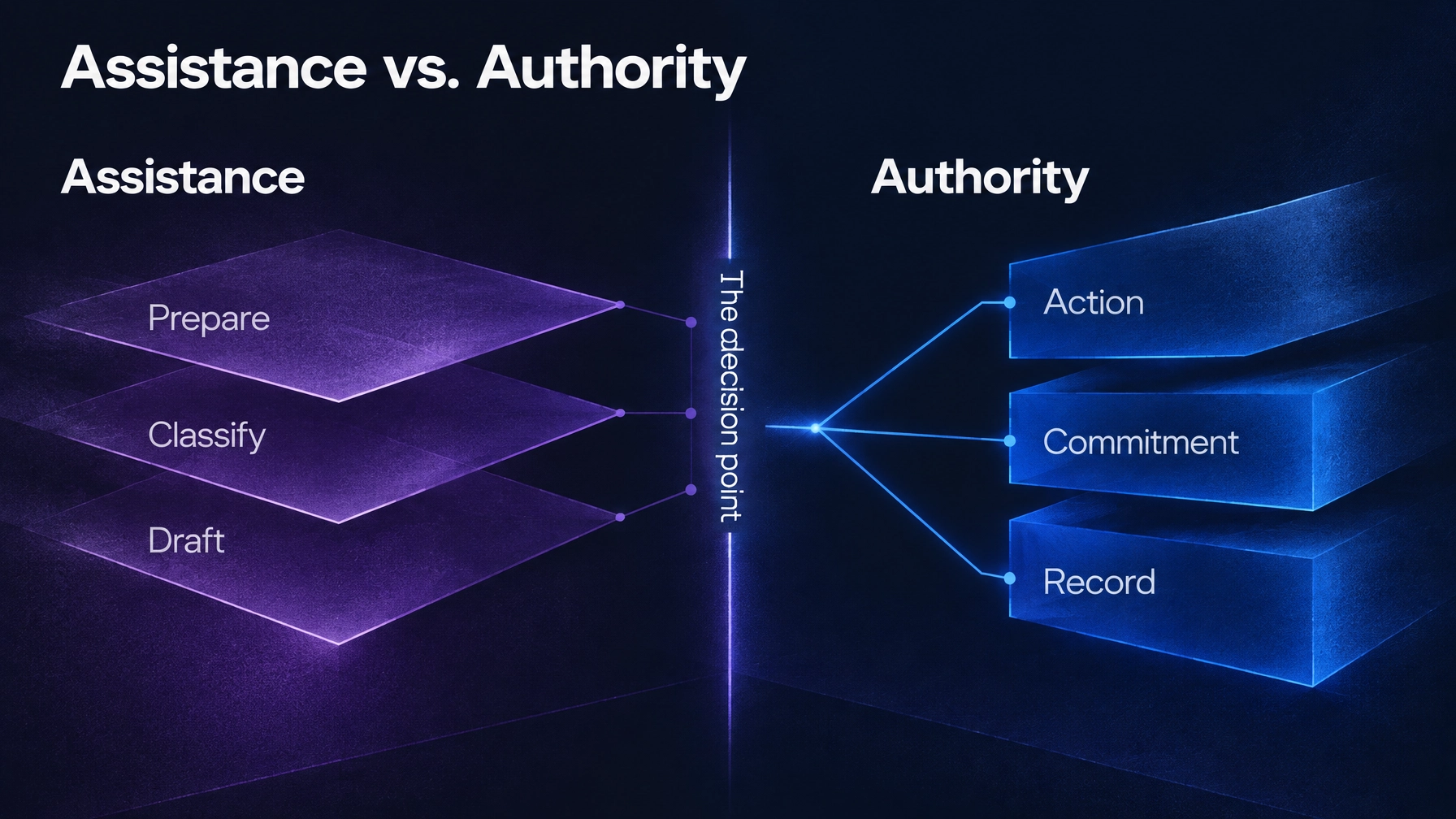
AI can assist with work without receiving authority over the outcome.
That boundary is easy to say and easy to blur when the workflow is designed around the tool rather than the decision.
A system may prepare a client response. The preparation is assistance. Sending the response creates a commitment.
A system may classify an expense. The classification is assistance. Approving the payment exercises authority.
A system may summarize an agreement. The summary is assistance. Deciding what obligation the business accepts belongs elsewhere.
A system may organize a set of customer requests. The organization is assistance. Deciding which request changes a commitment remains a business decision.
The business should decide where that boundary sits before configuring the workflow.
If the authority boundary is not explicit, an output can move farther than intended. One person assumes another person checked it. The person assigned to review may assume the system already applied the rule. The owner may believe the final action still requires approval when the workflow treats the output as complete.
Naming the authority point prevents that drift.
It also produces a better role for the human reviewer. The person is not simply confirming that an output exists. The person owns a defined decision: whether the output meets the standard, whether an exception is present, and whether the action may proceed.
AI controls become more practical when they are written as workflow decisions rather than broad statements about responsible use.
Information access belongs inside the operating design
The business should decide what information an AI-assisted workflow needs before granting access.
A convenient implementation can make broad access feel like the easiest option. The operating question is narrower: which information is necessary to produce the intended result?
The answer depends on the work.
A drafting workflow may need approved source material but not complete customer histories. A classification workflow may need transaction details but not unrelated personnel information. A meeting-summary workflow may need the recording or transcript but not standing access to every document in the workspace.
The same ownership logic applies to information that people currently handle informally.
Who may provide the information? Who may change it? Which source is authoritative? What should happen when the sources conflict or the information is incomplete?
These questions improve the workflow whether or not AI is involved. AI makes them more visible because the system can only operate within the information and permissions the business gives it.
A clear access boundary also improves review. The reviewer can evaluate the output in light of the sources the system was allowed to use. If the result depends on information outside that boundary, the workflow can stop or escalate rather than quietly filling the gap.
This is another reason to trace the work before choosing the tool. Access is not merely a technical setting. It is part of the operating decision.
Exceptions reveal whether ownership is real
The normal path is usually the easiest part of a workflow to describe.
Ownership becomes clearer when something does not fit.
A request arrives without required information. A customer asks for something outside the standard terms. Two sources disagree. An approval threshold is exceeded. A system produces an output that appears plausible but does not resolve the actual question.
The workflow needs somewhere for that work to go.
An exception path identifies who evaluates the issue, what information is required, what authority the person has, and how the final decision is recorded. Without it, the work usually returns to the owner or circulates until someone feels confident enough to act.
Automation does not remove exceptions. It makes the need to define them harder to ignore.
A useful stopping condition is therefore part of the control design. The system should not be expected to continue simply because it can produce another output. The workflow should pause when the information is incomplete, the consequence exceeds the approved boundary, or the result requires authority the system does not hold.
That pause is not a failure of automation. It is evidence that the business understands where the normal rule ends.
The owner of the exception path matters as much as the owner of the normal workflow. If nobody owns the exception, the system has only moved the original ambiguity to a different point.
Evidence closes the ownership loop
A governed workflow should leave enough evidence to understand what happened.
The appropriate record depends on the work. It may include the information supplied to the system, the output produced, the person who reviewed it, the approval or correction, the exception raised, and the final action.
The purpose is not to save every possible artifact. The purpose is to preserve what the business would need to evaluate the decision and improve the workflow.
Evidence can answer practical questions.
Was the source information complete?
Did the system operate within the approved instruction?
Did the reviewer see the information needed to make the decision?
Was an exception identified and routed?
Did the final action match what was approved?
Without that record, the business may know that something went wrong without knowing where the workflow failed. It may respond by adding more review everywhere, even if the actual problem was incomplete information or unclear authority.
Evidence makes the control structure testable. It shows whether ownership was exercised rather than merely assigned.
It also supports improvement. Repeated exceptions may reveal a process that needs repair. Frequent corrections may show that the instruction or source material is weak. A review step that never changes an outcome may need a clearer standard or a different position in the workflow.
The evidence is therefore not separate from the operating design. It is part of how the business learns whether that design is working.
One workflow is enough to begin
The business does not need to solve every AI-governance question at once.
Choose one workflow already creating pressure or attracting interest in automation.
Name the result. Trace the trigger, information, decisions, approvals, exceptions, and evidence. Identify the owner of each consequential choice.
Then decide which diagnosis applies.
If the work is necessary, stable, and clearly owned but exceeds the team’s capacity, the answer may still be another person.
If the workflow creates avoidable work, repair the process.
If decisions wait for permission, clarify ownership and authority.
If the activity is sufficiently understood and repeatable, identify the portion that can be automated.
When AI is part of that answer, extend the ownership step into the controls.
Define what the system may access, what it may produce, what remains a draft, what requires approval, who may change the operating rule, when the workflow must stop, and what evidence should remain.
That sequence keeps the tool in its proper place.
The business does not need perfect certainty before using AI. It needs a workflow it can explain and is prepared to own.
A new employee should inherit a role the business understands. A new system should support a process the business can describe. AI should operate inside boundaries the business has chosen deliberately.
Trace the work first. The right answer may still include AI. The difference is that the business will know what problem the tool is solving and who remains responsible for the result.
Key Takeaways
AI should enter a workflow only after the underlying capacity, process, ownership, and automation questions have been diagnosed.
Ownership connects workflow design to information access, review, authority, escalation, and evidence controls.
Human review is meaningful only when the reviewer has a defined standard, sufficient information, and authority to intervene.
AI assistance and business authority are separate, even when both appear in the same workflow.
Access and control requirements should reflect the intended result, the consequence of the action, and the sensitivity of the information.
Exception paths and retained evidence make ownership visible when the normal workflow does not apply.
Frequently asked questions about AI workflow ownership
Why should a workflow be traced before AI is added?
Tracing reveals the result, information, decisions, ownership, exceptions, and evidence already present in the work. Without that diagnosis, AI may automate activity while preserving an unresolved operating problem.
How does ownership affect AI controls?
Ownership identifies the person accountable for the result and the decisions that require authority. That accountability informs access boundaries, review requirements, escalation paths, and evidence retention.
What makes human review meaningful?
Meaningful review requires a defined standard, enough information to evaluate the output, time to intervene, and authority to stop or change the action. A nominal review step without those elements does not provide the same control.
What is the difference between AI assistance and authority?
Assistance prepares, summarizes, classifies, recommends, or drafts. Authority permits an output to become an action, approval, commitment, or official record.
What information should an AI-assisted workflow access?
Access should be limited to information needed for the intended result and permitted by the workflow’s owner. The design should also identify authoritative sources and define what happens when information is incomplete or conflicting.
How should an AI workflow handle exceptions?
An exception path should identify the conditions that stop the normal workflow, the person responsible for review, the information required, and the authority available. The decision and final action should be recorded when the consequence warrants it.
What evidence should an AI-assisted workflow retain?
Relevant evidence may include source information, system output, review or approval, corrections, exceptions, and the final action. The necessary record depends on the consequence and sensitivity of the workflow.
CP Product Advisory writes about practical business efficiency, clear decision ownership, and responsible AI adoption for owners and operators. Subscribe to the CP Product Advisory Substack for the next essay in this series.
If you're working through where AI belongs in your business and who needs to stay accountable, let's talk. Book a free Business Efficiency Advisory Call.