Decision Architecture: The Failure Starts Before the Metric Moves
Decision Architecture: The Failure Starts Before the Metric Moves
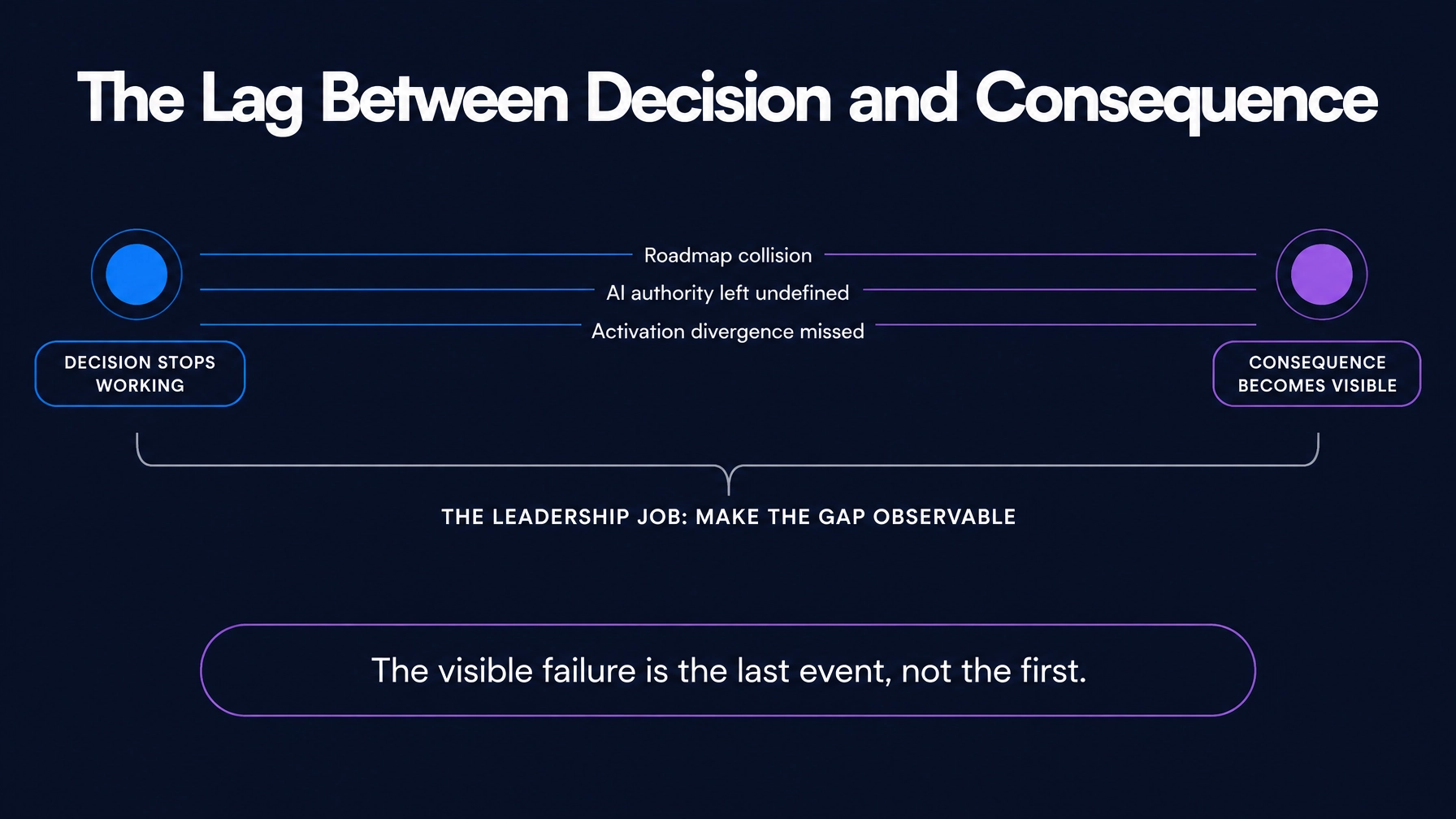
The visible failure is usually the last event in a decision that stopped working much earlier.
TL;DR
Decision architecture is the operating structure that keeps an important choice usable after the meeting where it was made. A decision becomes durable when ownership, boundaries, evidence, and the rules for change are explicit. Without that structure, roadmap priorities reopen under pressure, AI systems act beyond a trusted boundary, and churn is diagnosed at cancellation rather than at the earlier loss of value. The practical leadership job is to make the decision observable while there is still time to intervene. This reduces late surprises and gives execution teams a stable basis for judgment.
The lag hides the real failure
Leaders usually meet a problem after it has become expensive.
A roadmap misses a commitment. An AI pilot produces an answer nobody is prepared to trust. A customer cancels after months of apparently normal activity. By the time the issue reaches an executive room, it has a metric, a deadline, and a team attached to it.
That makes the visible event feel like the problem. It rarely is.
The missed commitment may have started when a new priority entered the roadmap and nothing else moved. The AI failure may have started before the pilot, when nobody defined which decisions belonged to the system and which still required a person. The cancellation may have started during activation, long before the account appeared on a churn report.
Different symptoms. Same operating mistake.
The business made a decision, but it did not build the conditions that would keep that decision intact, visible, and correctable as the work moved.
I have seen this across product organizations, platform work, and operating-model redesign. The meeting is often treated as the hard part. Get the right people together, choose a direction, write down the action, move on.
But the meeting is only where the choice becomes explicit. The operating system determines whether the choice survives contact with new evidence, competing pressure, and the dozens of smaller decisions that follow.
That is where a surprising amount of strategy disappears.
Agreement is not the same as durability
An approved roadmap can still be unstable.
Revenue has a legitimate customer commitment. Risk has an obligation the business cannot ignore. A platform dependency threatens several teams at once. Leadership adds the new priority because the need is real.
The trouble begins when the original plan stays untouched.
Now delivery is carrying two strategies. The roadmap still shows the earlier commitment, while the organization behaves as if the urgent work has equal or greater priority. Dependencies multiply. Teams protect the work they already started. Sponsors defend the promises they already made. Everybody can explain why their request matters, and nobody can point to the rule that resolves the collision.
Another planning session will not fix that.
The missing decision is displacement. If this work enters, what loses time, people, or scope? If nothing changes, leadership has recorded a preference and passed the tradeoff to the teams with the least authority to make it.
Durability also requires a reopening threshold. New evidence should be able to change a decision. That is different from allowing every escalation to reopen it. A roadmap that can never change becomes detached from reality. A roadmap that can change for any loud request stops carrying strategic meaning.
The question is not whether the plan is flexible. The question is whether the business has named what evidence is strong enough to change it, who owns that call, and which constraints must remain protected while the change is made.
That structure gives teams room to adapt without asking them to negotiate strategy through delivery work.
Boundaries turn AI intent into an operating decision
AI creates the same problem in a newer form.
Leaders feel pressure to use it before they can name the job they want it to do. A tool is selected, a pilot begins, and the organization starts testing outputs. The work looks active. The underlying decision is still unfinished.
An AI use case becomes real when the business can say which decision or task is being improved, what outcome matters, and what information the system needs to produce an acceptable result.
Then the authority has to stop somewhere visible.
A system may classify a request, prepare a recommendation, or move routine work through a defined path. Context, judgment, and accountability still have to live somewhere. The business needs to know when the system may act, when a person must decide, and what happens when the output is uncertain or wrong.
This is not a philosophical debate about whether humans or machines are better. It is operating design.
If the boundary is vague, a confident output can look like progress because the system completed a task. Nobody can say whether it made the right decision, used the right evidence, or crossed into authority the organization never intended to delegate.
Trust does not come from monitoring the tool more closely after the fact. It comes from defining the evidence, exceptions, and recovery path before the tool begins acting.
Who reviews the exception? What standard are they applying? Can they reverse the call? What happens to work already in motion? Those answers turn an AI experiment into a business process the organization can actually own.
And this is the part that gets lost when AI strategy starts with a catalog of use cases. The useful question is not where AI can be inserted. It is where the business has enough clarity about the decision to let a system participate without hiding the judgment that still matters.
Late metrics send the roadmap toward the wrong work
Churn shows the same lag from the other direction.
In one operating role, I worked with a B2B subscription platform where too many new subscribers were leaving. Acquisition was working, so the obvious response was to keep adding features that might give customers another reason to stay.
I started earlier in the journey.
We mapped the customer path, talked with customers who had already left, and compared the behavior of accounts that stayed with the behavior of accounts that cancelled. The paths separated during activation.
Customers who reached useful value early behaved differently from those who never got there. The cancellation appeared months later, but the business had already lost the customer much closer to the beginning.
That changed the product decision.
The problem was not a shortage of possible features. The problem was that the roadmap was reacting to the last visible event instead of the first meaningful divergence. Once the team could see the earlier signal, it could move attention toward activation and engagement while there was still time to affect the path.
This is why metrics need a decision attached to them.
A churn number can describe the damage without showing where the work belongs. A dashboard can make the outcome visible and still leave the team debating acquisition, onboarding, product value, pricing, support, and save tactics. More data does not settle that argument by itself.
The useful signal is the one that changes a choice soon enough to matter.
Where do retained and lost customers first behave differently? What moment of value predicts continued use? Which product decision controls that moment? What can the team observe before cancellation? What will the roadmap stop so the new priority has real capacity behind it?
Those questions move the work from reporting the failure to finding the decision that created the path.
Decision architecture makes judgment observable
Decision architecture is the operating structure that keeps an important choice usable after the room moves on.
It is not another approval layer. It does not mean every decision needs a committee, a template, or a permanent governance forum. The point is to make the minimum structure visible enough that the organization can act, learn, and recover without renegotiating the decision through every downstream task.
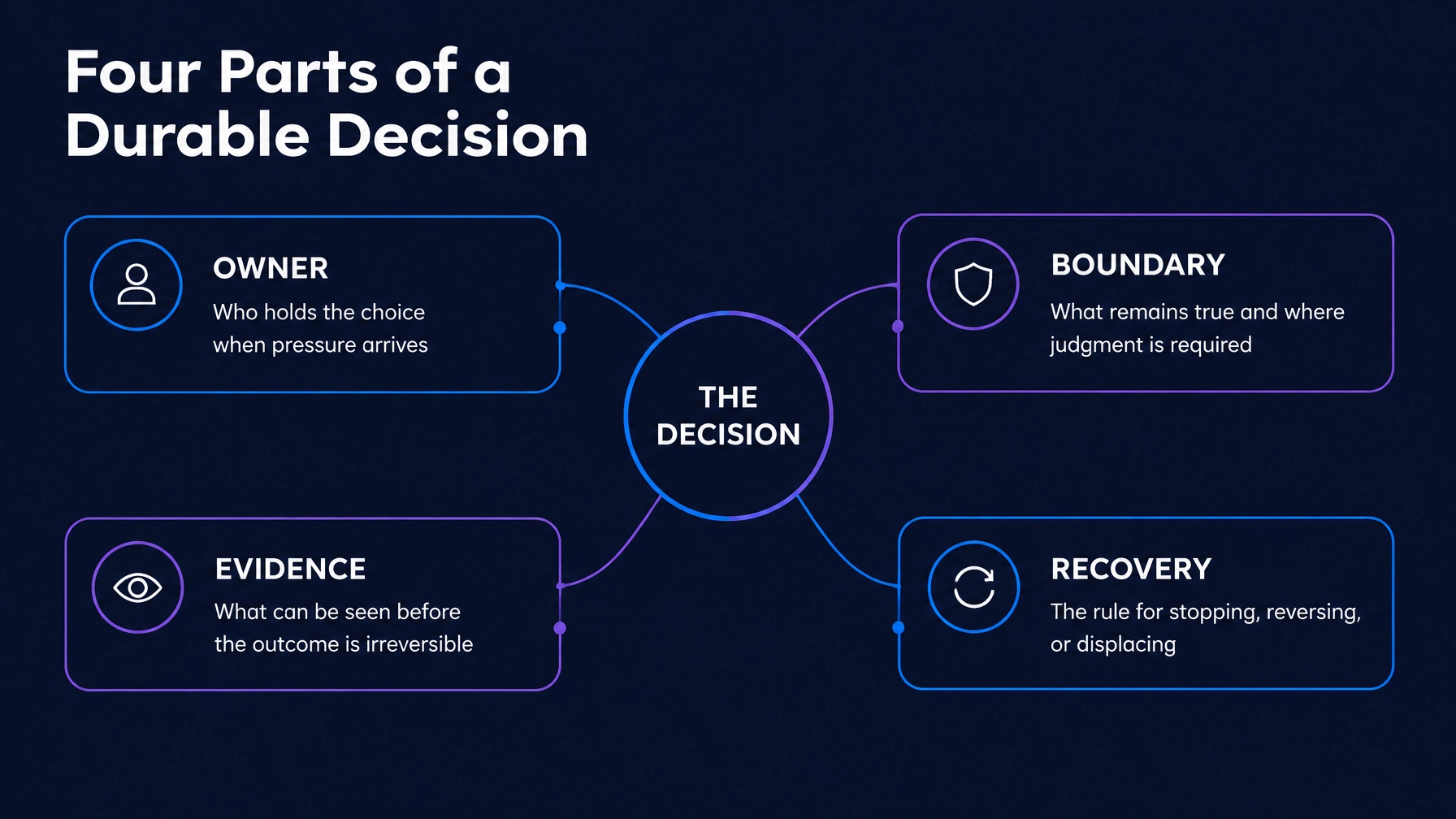
Four parts matter most.
First, the decision needs an owner after approval. Someone has to hold the choice when new pressure arrives, new evidence appears, or the work crosses into another team.
Second, the boundary has to be explicit. The roadmap protects certain constraints. The AI system acts inside a defined scope. The activation work targets a specific moment of value. A boundary tells people what remains true and where judgment is still required.
Third, the business needs evidence it can use before the outcome is irreversible. That may be the threshold for reopening a roadmap decision, the standard for evaluating an AI output, or the early behavior that separates retained customers from lost ones.
Fourth, there has to be a recovery or displacement rule. A new priority pushes something else. A bad automated decision can be stopped or reversed. A late metric sends the team back to the earlier point where the path changed.
These are not four boxes to complete for every minor choice. They are the questions that reveal whether a consequential decision has enough structure to survive execution.
Without them, teams compensate with meetings, escalation, and local judgment. Smart people keep the work moving, but each team builds its own version of the strategy. The disagreement remains hidden until a dependency breaks, a customer leaves, or a system produces an answer the business cannot defend.
By then, leadership is managing the consequence instead of the decision.
There is another cost here that does not always reach a dashboard. Every unclear decision creates interpretation work. A product team has to guess which commitment is protected. An operator has to decide whether an AI exception is safe to approve. A customer team has to explain a cancellation without knowing when the relationship first went off course.
That interpretation work looks like collaboration from a distance. People hold more meetings, write more status updates, and add more checkpoints because they are trying to recover the structure that should have traveled with the decision. The activity can be real and still leave the core question unresolved.
This is why I do not treat decision architecture as documentation. A record of the choice matters, but the operating value comes from what the record allows someone else to do. Can they act without inventing the strategy? Can they recognize when the evidence has changed? Can they stop or reverse the work without waiting for the original room to reconvene?
When those answers are clear, leadership does not disappear from the system. Its judgment becomes usable beyond the moment when it was first expressed.
Leaders need earlier truth, not more activity
The practical test is simple: can the organization see the decision while there is still time to change the outcome?
Can a team explain what leaves the roadmap when a new priority enters? Can an AI operator identify the point where the system's authority ends and a person takes over? Can a product leader find the first meaningful divergence in the customer journey before the account cancels?
Those are not separate management disciplines. They are versions of the same leadership job.
Make the decision clear enough to travel. Make the evidence early enough to use. Make the boundary visible enough that people know where their judgment begins. Make recovery possible before the consequence becomes the only thing anyone can see.
The goal is not to prevent change. It is to stop change from becoming invisible.
A durable decision can absorb new evidence without losing its owner. A trustworthy system can act without hiding its limits. A useful metric can redirect work before the customer is already gone.
That is how leadership moves upstream of the failure. The metric still matters, but it no longer has to be the first moment the organization realizes the decision stopped working.
Key Takeaways
Decision architecture keeps an important choice usable after the meeting where it was made.
Visible failures often lag the earlier decision breakdown that caused them.
Roadmap durability requires ownership, a reopening threshold, protected constraints, and a displacement rule.
Trustworthy AI use cases define the business decision, operating boundary, evidence standard, exception path, and recovery authority.
Churn analysis is more actionable when it identifies the first meaningful divergence in customer behavior rather than treating cancellation as the starting point.
Early evidence is valuable only when it is connected to a decision the organization can still change.
Durable decisions allow new evidence to change the plan without letting every escalation erase the strategy.
Frequently Asked Questions About Decision Architecture
What is decision architecture?
Decision architecture is the operating structure that defines how consequential choices are owned, bounded, supported by evidence, changed, and recovered when conditions shift. It keeps a decision usable after the meeting where it was made and reduces the need to renegotiate strategy through downstream execution.
Why do approved roadmaps still fail?
Approved roadmaps fail when the organization has not defined who owns the decision after approval, what evidence can reopen it, which constraints are protected, and what must move when a new priority enters. Without those rules, delivery teams carry competing strategies and absorb tradeoffs they do not have the authority to resolve.
What makes an AI use case trustworthy?
A trustworthy AI use case names the business decision or task being improved, the outcome that matters, the information required, and the boundary between system action and human judgment. It also defines acceptable evidence, review conditions, exception ownership, and a recovery path for uncertain or incorrect results.
How does decision architecture relate to churn?
Decision architecture connects a lagging metric such as churn to an earlier product choice the organization can still influence. The diagnostic work identifies where retained and lost customer paths first diverge, which behavior signals useful value, and which roadmap decision controls that moment.
Does decision architecture add more governance?
Decision architecture does not require more governance by default. It adds only enough structure to make ownership, boundaries, evidence, and change rules explicit for a consequential decision. The aim is fewer late escalations and less local interpretation, not more approval theater.
How can leaders tell whether a decision is durable?
A durable decision can survive new pressure without becoming ambiguous. The organization can name the owner, the evidence threshold for change, the constraints that remain protected, and the displacement or recovery action that follows when the decision changes.
I help executives at companies built through acquisition achieve numbers nobody argues about, a room they are never surprised in, and a business that is easier to run and easier to sell, so they can stop defending their reporting and start leading with authority.
If this sounds familiar, you're not alone.
The work is not about moving faster. It is about preserving judgment as systems scale.
If you are navigating this right now, start with a Relevance Check. It is a quick 15-minute conversation to determine whether it makes sense to proceed.
No pitch. Just the read.
Clinton Pracher | CP Product Advisory