Decision Architecture Starts by Tracing the Work Before Hiring or Automating
Sometimes the next hire is being asked to absorb a decision the business never made.
Decision Architecture is the structure that clarifies how information, authority, approval, and evidence move through a workflow. When a growing business feels overloaded, the pressure may come from insufficient capacity, a broken process, unclear ownership, or work that is ready for automation. Tracing the workflow before choosing a solution separates those problems and makes the operating decision more precise. The same diagnosis also establishes the ownership and controls needed before AI enters the workflow. The payoff is not automation for its own sake, but a business that knows what should happen, who is accountable, and what evidence should remain.
Growth pressure often looks like a capacity problem
One of the stranger parts of growth is how quickly a successful business can begin to feel disorganized.
The work is getting done. Customers are being served. Revenue is moving in the right direction. But the owner is still answering questions that should not need the owner. A capable employee is spending part of every day moving information between systems. Something important lives in an inbox because nobody is sure where else it belongs. A routine approval waits until the one person everyone trusts has time to look at it.
The pressure is real, but the first explanation is often too simple.
The business appears busy, so the answer becomes another person. Or the work appears repetitive, so the answer becomes another tool. More recently, the answer may become AI before anyone has described the work clearly enough to know what AI would be responsible for doing.
Sometimes more capacity is exactly what the business needs. Sometimes automation is appropriate. But neither decision should be made from the feeling of being busy.
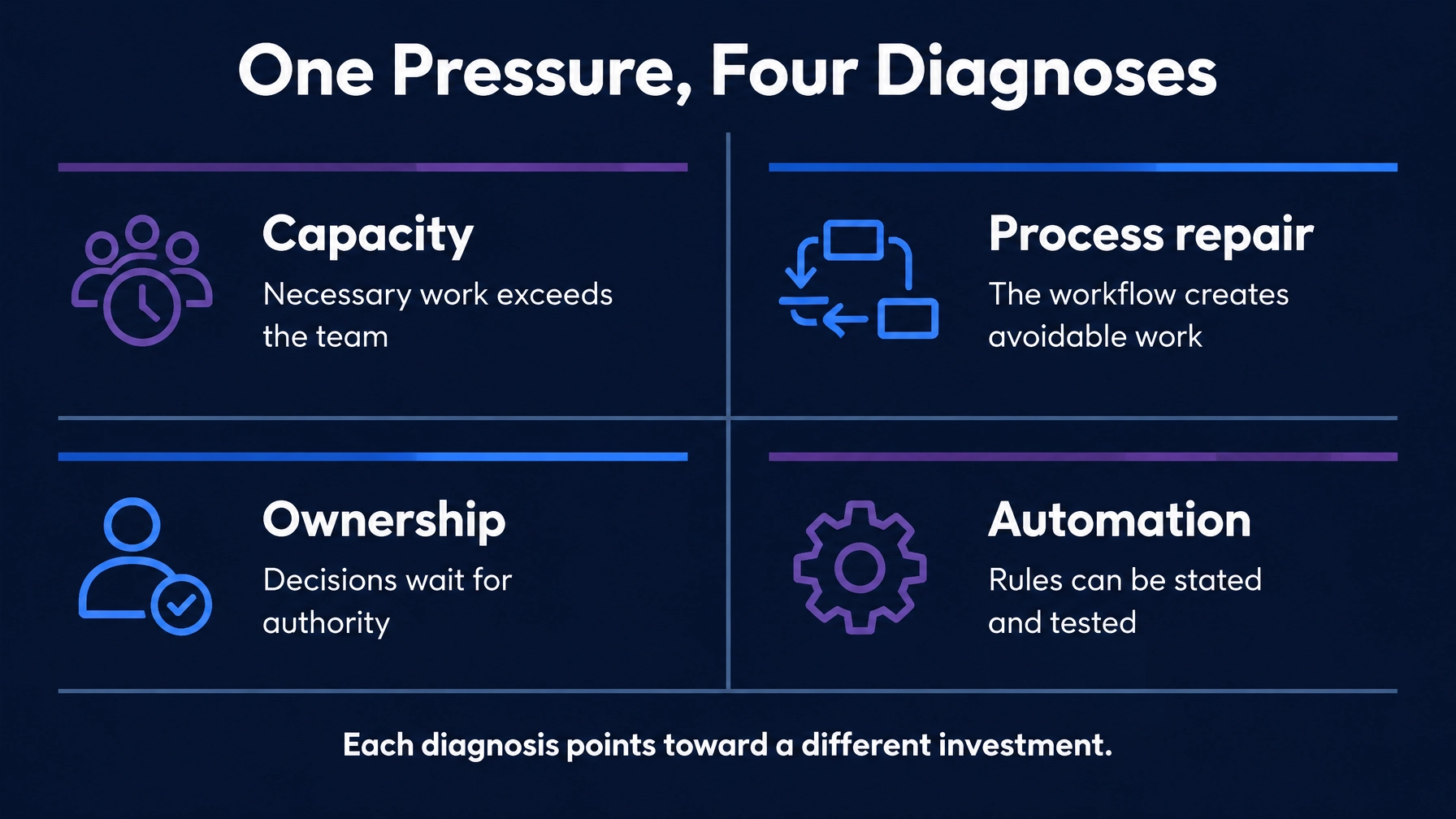
A crowded workflow can hide several different operating problems. There may be more demand than the current team can reasonably handle. There may be unnecessary steps that create work without improving the result. There may be a decision that has never been assigned clearly. There may be repetitive, rules-based activity that a system could handle once the rules are understood.
Those are not four descriptions of the same problem. They are four different diagnoses, and each one points toward a different investment.
That is why the useful starting point is not the job description or the software demo. It is the work itself.
The workload must be traced before it is priced
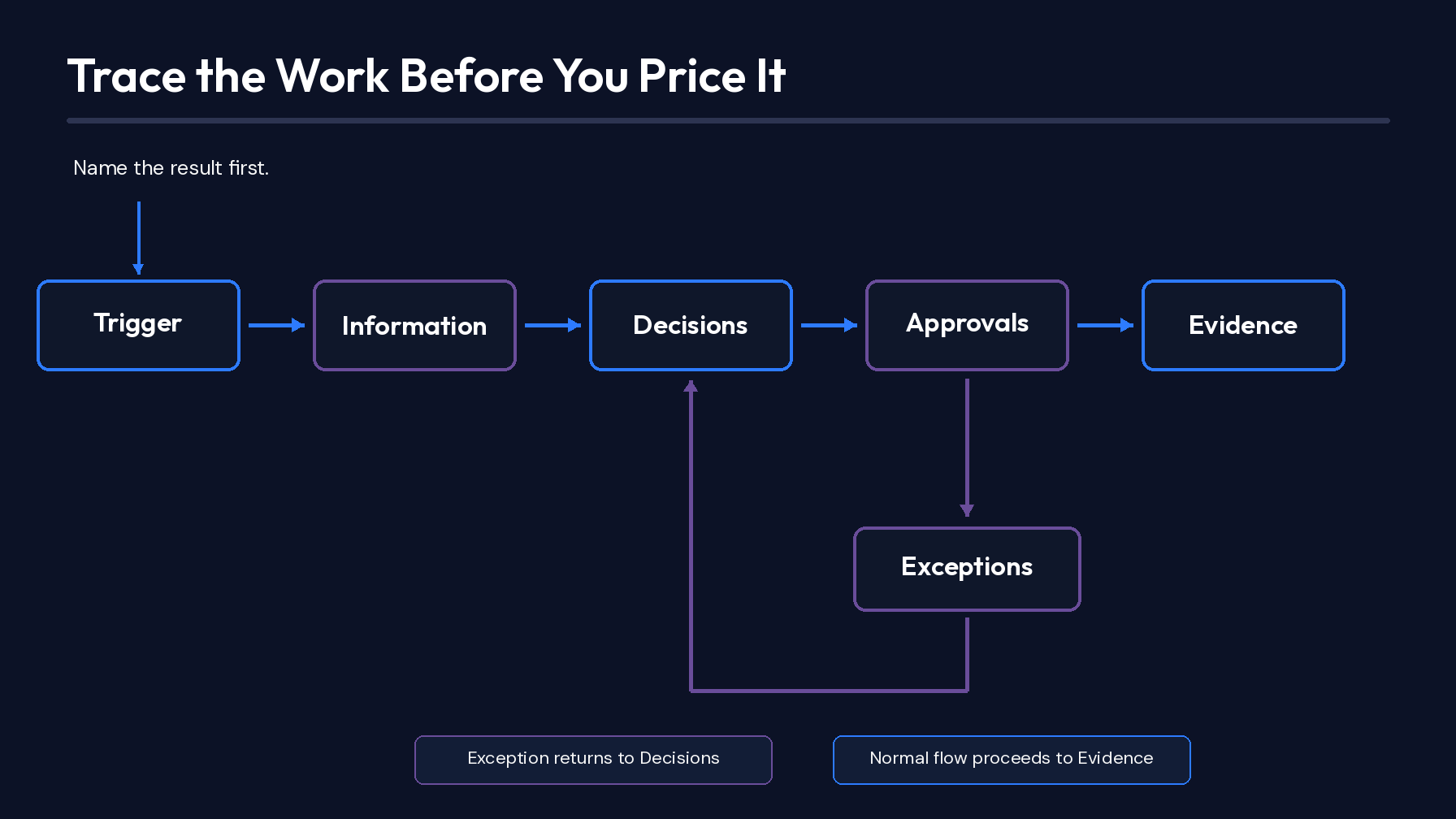
Tracing the work means following one meaningful result from beginning to end.
Start with the outcome the business actually needs. Then identify what triggers the work, what information enters, what changes along the way, where judgment is required, who approves the result, and what evidence remains when the work is complete.
That sounds basic. In practice, it often exposes how much of the workflow has been held together by memory, habit, and goodwill.
A customer request arrives by email. Someone copies it into another system. A second person checks whether the information is complete. A third person knows which exception matters because that exception has happened before. The owner approves the final action, partly because the owner has the authority and partly because nobody has ever decided who else should.
If that workflow is described only as a list of tasks, the business may conclude that it needs another set of hands. The tasks are visible. The decisions between the tasks are not.
The better question is what result each activity protects.
Some activities move the work forward. Some verify that the information is trustworthy. Some resolve an exception. Some create a record. Some exist because an earlier system could not do something. Some continue because removing them would require an ownership decision nobody has made.
The point is not to eliminate every manual step. Manual work may be appropriate when the consequences are meaningful, the volume is low, or judgment genuinely matters. The point is to understand why the step exists before paying a person or a tool to repeat it.
A workflow becomes easier to evaluate when the work, information, decisions, approvals, and evidence are visible in the same picture. That picture usually makes the next choice less dramatic and more specific.
Decision Architecture makes ownership visible
Decision Architecture is the explicit structure that connects information, authority, approval, and evidence inside a workflow.
It answers a set of operating questions that job descriptions and software configurations often leave unresolved.
What decision is being made? What information is needed to make it? Who has the authority to make it? Which conditions require review? What happens when the normal rule does not apply? What record should remain after the decision is made?
A business can have a documented process and still have weak Decision Architecture. The steps may be written down while the authority remains implied. A system may route a request correctly while nobody owns the exception. A manager may approve an action without knowing what evidence the approval is meant to confirm.
That ambiguity creates hidden work. People ask for reassurance. The same issue is reviewed twice. Employees wait for the owner because the cost of acting without permission feels higher than the cost of delay. The owner stays involved because the owner can see that the process is not carrying the judgment safely.
In that environment, another employee may absorb the uncertainty without resolving it. A new system may move the uncertainty faster. AI may produce an answer without making the accountability any clearer.
Decision Architecture does not mean that every choice needs a committee or a thick policy manual. It means the business has made the important decisions about the workflow before asking people or technology to execute it.
For ordinary work, that may be a simple rule, a named owner, a defined exception path, and a record of the outcome. For more consequential work, it may include approval thresholds, information-access boundaries, review requirements, and a stronger evidence trail.
The structure should match the consequence. What matters is that it exists.
Capacity, process, ownership, and automation solve different problems
A useful workflow diagnosis separates four possible answers.
Capacity is the answer when the work is necessary, the process is sound, ownership is clear, and the remaining workload exceeds what the current team can reasonably perform.
That is a legitimate hiring case. The business knows what result the role must produce, what decisions belong to the role, and how the work fits into the operation. The new person is being added to perform understood work, not to discover what the business meant.
Process improvement is the answer when the result matters but the path to it creates avoidable work.
The workflow may contain duplicate entry, unnecessary handoffs, repeated checking, or steps preserved from an older way of operating. Adding capacity to that process may relieve the immediate pressure, but it also makes the inefficiency more expensive and harder to change later.
Ownership clarification is the answer when work stalls around authority, approval, or exceptions.
In this case, the team may appear understaffed because people spend time seeking decisions. The owner may appear to be the bottleneck because unresolved questions continue to return to the person with the broadest authority. The underlying issue is not always a lack of effort. It may be that nobody has been given a clear boundary within which to act.
Automation is the answer when the activity is understood, sufficiently stable, and governed by rules that can be stated and tested.
Automation works best when the business knows what the system should do, what information it may use, what conditions require escalation, and what evidence should be retained. A repetitive task is not automatically ready for automation. Repetition may simply mean the business has repeated the same ambiguity many times.
These answers can also work together. A workflow may need a process repair before automation, then additional capacity for the judgment-heavy portion that remains. Ownership may need to be clarified before a role can be designed properly. Automation may reduce administrative load without eliminating the need for human review.
The value of the diagnosis is not that it forces a single answer. It prevents the business from treating every kind of pressure as the same purchasing decision.
Automation inherits the decisions already inside the workflow
Automation turns prior operating judgment into rules, permissions, thresholds, and exceptions.
That is why tracing the work matters before choosing the tool.
If a process depends on someone recognizing incomplete information, the automated workflow needs a definition of complete. If a person currently decides when an exception is important, the system needs an escalation condition. If an employee is trusted with sensitive information because of the employee’s role, the technology needs an equally deliberate access boundary.
Without that work, implementation tends to begin with visible activity rather than operating responsibility. The business identifies a task that takes time, configures a tool to perform part of it, and discovers later that the task contained more judgment than the original description showed.
The problem is not necessarily that the technology failed. The business may have asked the technology to execute a decision that had never been made explicitly.
A useful automation candidate has a clear trigger, a defined input, a stable expected result, and an identifiable owner. Exceptions are known well enough to route somewhere. The outcome can be reviewed. The business can tell whether the automated action was appropriate after it happened.
That does not require predicting every possible situation. It requires being honest about where the normal rule ends.
The workflow also needs a stopping point. Someone must know when the automated action should pause, when human review is required, and who has the authority to change the rule. Otherwise, the tool becomes another source of operating ambiguity.
The decision to automate should therefore include the operating controls, not follow them as cleanup.
AI makes unresolved ownership harder to ignore
When a business uses AI to summarize, classify, recommend, draft, or select, the workflow still needs an accountable owner.
The business must decide what work the system is allowed to perform. It must decide what information the system may access, what output requires review, who can approve an action, and what evidence should remain.
These are operating questions before they are technical questions.
An owner remains accountable for what the business sends, promises, approves, records, and relies upon. Delegating part of the work to AI does not transfer that accountability to the model or the software provider.
That does not mean every AI-assisted activity requires the same level of control. Drafting an internal outline is different from approving a payment. Summarizing a meeting is different from making a client commitment. The controls should reflect the consequence of the action and the sensitivity of the information involved.
The important distinction is between assistance and authority.
AI may assist with research, preparation, classification, or drafting. Authority determines whether the output becomes an action, a commitment, a record, or a decision. When those two ideas are blurred, the business may believe a human is “in the loop” even though the human has no meaningful review standard or practical opportunity to intervene.
The workflow should make that boundary visible. It should also identify the evidence needed to show what occurred: the source information, the generated output, the review or approval, and the final action where appropriate.
AI controls are not a separate layer added after automation. They are the ownership decisions inside the workflow, made explicit enough to govern the tool.
A practical diagnosis starts with one workflow
The business does not need to map everything at once.
Choose one workflow creating visible pressure. It might be delaying customer work, pulling the owner into repeated approvals, generating rework, or prompting a discussion about hiring or automation.
Name the result first. Avoid starting with the activities people currently perform. A result such as “a complete customer request is approved and scheduled” is more useful than “manage the inbox.”
Then trace the work from trigger to completion.
Identify what information arrives, where it comes from, and who can change it. Mark the decisions people make, including the small decisions that experienced employees may no longer notice. Name the owner of each consequential choice. Separate normal work from exceptions. Record what evidence remains when the result is complete.
Only then compare the four responses.
If the work is necessary, stable, and clearly owned but there is too much of it, capacity may be the answer.
If the workflow contains duplicate effort or unnecessary handoffs, repair the process.
If work waits for permission or repeatedly returns to the owner, clarify ownership and authority.
If the activity is sufficiently understood and repeatable, identify the portion that can be automated and define the controls around it.
This sequence often changes the original question. “Who should we hire?” becomes “Which work actually requires another person?” “What should we automate?” becomes “Which part of this workflow has a clear enough rule and owner to automate responsibly?”
Those are better questions because they preserve the reason the work exists.
Growth creates pressure to act. That pressure is not a reason to delay every decision until the process is perfect. It is a reason to make the next investment against a visible operating problem.
A new employee should inherit a role the business understands. A new tool should support a process the business can explain. AI should operate inside boundaries the business is prepared to own.
Trace the work first. The right answer may still be another person or another tool. But the business will know what problem that investment is being asked to solve.
Key Takeaways
Decision Architecture clarifies how information, authority, approval, and evidence move through a workflow.
Business pressure may reflect insufficient capacity, process friction, unclear ownership, or work that is suitable for automation.
A hiring decision is stronger when the necessary work, decision rights, and expected result are already understood.
Automation is appropriate only when the activity, rules, exceptions, owner, and review requirements can be stated clearly.
AI assistance does not transfer accountability away from the business using it.
AI controls should define information access, review requirements, decision authority, escalation conditions, and retained evidence.
Frequently asked questions about Decision Architecture
What is Decision Architecture?
Decision Architecture is the explicit structure connecting information, authority, approval, and evidence within a workflow. It clarifies what decisions occur, who owns them, which conditions require escalation, and what record remains.
How can a business tell whether it needs more capacity?
A capacity need exists when necessary work follows a sound process, has clear ownership, and still exceeds what the current team can reasonably perform. If work is being created by duplication, unclear authority, or unnecessary handoffs, hiring alone may not resolve the cause.
When should a workflow be redesigned?
A workflow should be reconsidered when avoidable handoffs, duplicate entry, repeated checking, or unclear exception paths create delay or rework. Redesign should preserve the result and necessary controls while removing activity that does not protect either.
What makes a workflow ready for automation?
A workflow is a stronger automation candidate when it has a clear trigger, defined inputs, a stable expected result, known exceptions, and an identifiable owner. Review requirements and evidence retention should be defined before the automated activity begins.
Why does ownership matter before AI adoption?
Ownership establishes who remains accountable for the information used, the output produced, the review performed, and the action taken. AI can assist with work, but it does not assume the business authority attached to that work.
What AI controls belong in a business workflow?
Relevant controls may include information-access boundaries, approval thresholds, human-review requirements, escalation conditions, change authority, and evidence retention. The appropriate controls depend on the consequence of the action and the sensitivity of the information.
Does every manual task need to be automated?
Manual work may remain appropriate when judgment is material, volume is low, exceptions are frequent, or the consequence requires direct review. Repetition alone does not establish that a task is ready for automation.
For owners and operators deciding where people, process, and AI belong in the business. CP Product Advisory helps clarify the work, the ownership, and the operating choice before another role or tool is added. Follow Clint Pracher on LinkedIn for practical thinking on business efficiency, decision ownership, and responsible AI adoption.
If you're working through where AI belongs in your business and who needs to stay accountable, let's talk. Book a free Business Efficiency Advisory Call.