
Decision architecture gives leaders room to lead

An AI agent can carry the work. Only decision architecture lets it carry the responsibility.
TL;DR
Decision architecture is the design of who owns an outcome, what authority they hold, when they escalate, what evidence they return, and when a decision is closed. Organizations that hand work to AI agents without that structure keep the coordination and the troubleshooting with leadership even as task output grows. Delegation becomes useful when company goals, execution ownership, decision authority, and evidence stay connected instead of transferring only the task. In one advisory practice, recorded agent execution ownership moved from 36.6 percent of open goals to 75.7 percent across two dated snapshots, a measure of assigned ownership rather than completed outcomes. The payoff is capacity: leadership hours return to direction, tradeoffs, and relationships, which is where judgment cannot be delegated.
A few fixes were sitting on my to-do list on a Friday, and my plan for them was the usual one. Open each item, work out what actually broke, decide who needed to know, and chase it until it stopped being my problem. Call it troubleshooting. Call it the tax you pay for being the person who knows how the pieces connect.
I did not do that. I handed the list to the agent I run as my Chief of Staff, told it what I wanted to be true by the end of the day, and went back to my actual work. It took the responsibility for coordination, worked out what each fix needed, and passed the execution to another agent. The notifications thinned out. The list got shorter.
My estimate is that it spared me about two hours of troubleshooting. I want to be careful with that number, because it is my estimate of time avoided and not a measurement of anything. I did not stand over a stopwatch. What I can say with more confidence is what did not happen: I did not spend the afternoon being the switchboard for a handful of small problems, and the day stayed mine.
Handing over work is not the same as handing over responsibility
The version of this that most leaders live with looks different. They add agents, and the agents do real work, and the leader is still the one holding every handoff and every exception. The task moved. The load did not.
That is the part people miss when they decide the answer is more agents, or better agents, or an agent for the thing the last agent could not do. Capability was never the constraint. The constraint is that nothing in the system says who is on the hook after the assignment leaves the room.
So the leader keeps doing the invisible job. They remember which decision is still open. They notice when two people are working from different versions of the same fact. They absorb the escalation nobody else wanted to take. None of it shows up as a task, which is exactly why it never gets delegated, and why adding automation somewhere else does not touch it.
A tool that finishes work faster while the coordination stays with the leader has moved the bottleneck, not removed it. You now have more output arriving at the same single point of judgment.
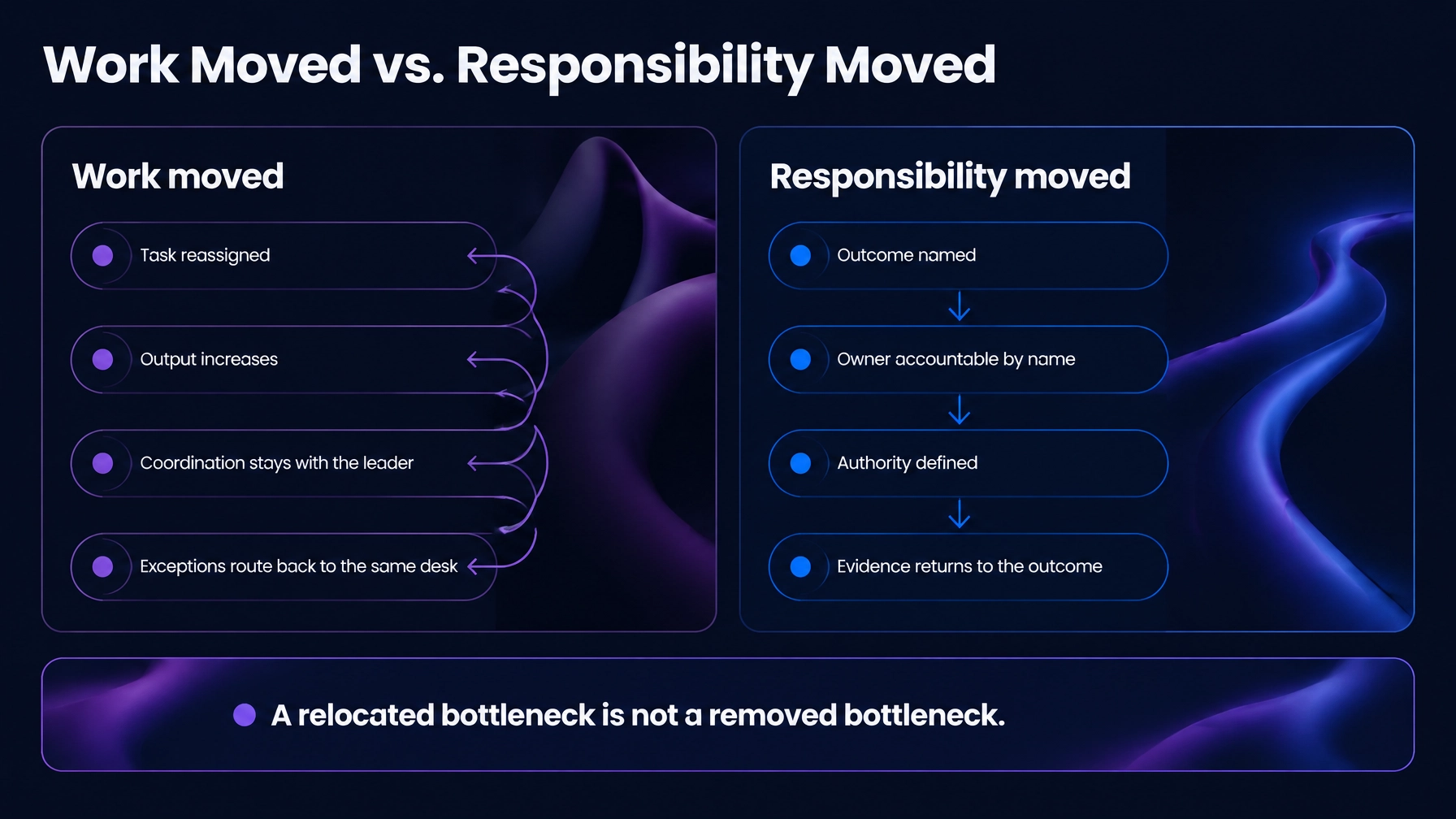
Decision architecture is the structure that makes a handoff hold
Decision architecture is the design of how decisions get made as a company grows: who owns an outcome, what authority they carry, when they escalate, what evidence they return, and when a decision is closed. Applied to agents, it is what turns a transfer of work into a transfer of responsibility.
The shape of it is simple to say and hard to build. Company goals flow into measurable outcomes. Outcomes flow into execution work. Execution work flows into agent assignments. Every assignment carries defined authority. The work has to return evidence that connects it back to the outcome it was meant to serve.
Read that as one connected line rather than four separate systems, because that is the whole mechanism. Break it anywhere and the leader is back in the middle. Break it at authority and the agent does things nobody approved. Break it at evidence and you cannot tell whether the work did anything. Break it at closure and the same decision resurfaces next month wearing a slightly different question.
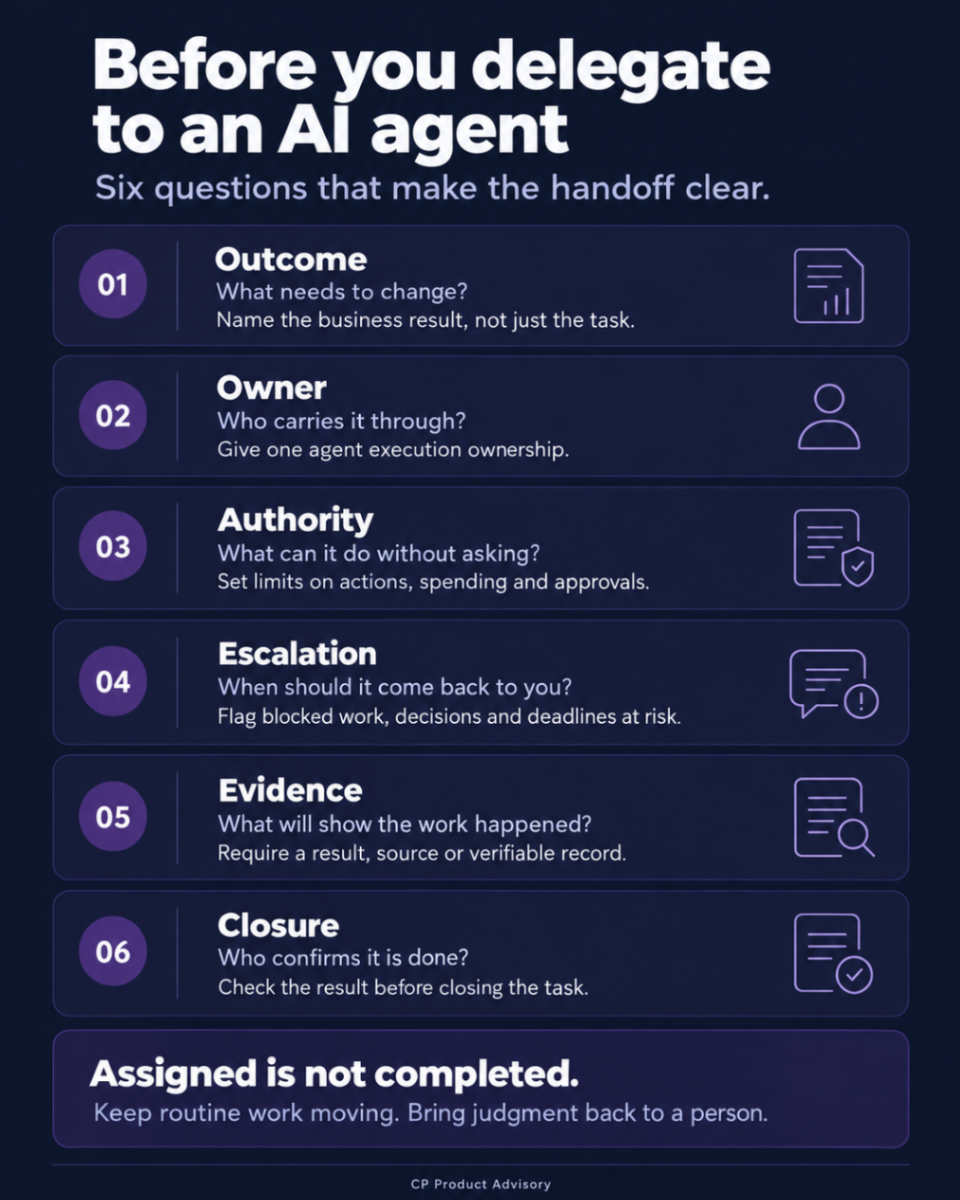
The six conditions that keep a handoff honest
When I designed my own system, the checks that mattered were the ones I could answer without opening a dashboard. There were six, and I have come to think of them as the conditions a handoff needs before it deserves to leave my desk.
The first is outcome. An assignment starts from the result it is supposed to produce, not from the activity it is supposed to perform. If I cannot name the outcome, I am not ready to delegate the work.
The second is owner. Someone is accountable by name, and it is not a team or a role or a shared understanding. A distributed owner is the same as no owner, and it is how things end up back with the founder.
The third is authority. The owner knows what they are allowed to decide and what they are not. This is where most agent programs quietly fall apart, because they grant access without ever granting or withholding decision rights. An agent that can reach a system is not the same as an agent that is cleared to change it.
The fourth is escalation. There is a defined path for the moment the work exceeds the authority, and the path does not route by default to the person who is hardest to say no to. Escalation is a feature of a healthy system, not a sign the delegation failed.
The fifth is evidence. The work returns something that connects it to the outcome, whether that is a receipt, a record, or a durable note that survives the conversation it came from. Without evidence, you are trusting a claim rather than checking a result.
The sixth is closure. Someone decides the thing is finished, and that decision is recorded, so it stops being reopened at the next planning cycle.
These are not a sequence to march through. They are the conditions under which a handoff carries responsibility instead of just moving a task, and the test is whether you can answer all six from memory for the work in front of you. If you cannot, the work is not delegated. It is parked somewhere that looks tidy.
What the recorded numbers do and do not show
I can show the ownership shift from my own operating record, and I want to be precise about what the record measures, because it is easy to overread.
Across two dated snapshots, recorded agent execution ownership rose from 70 of 191 open goals, or 36.6 percent, to 140 of 185, or 75.7 percent. That is a rise of roughly 39 percentage points in recorded execution ownership. Open goals still sitting with me fell from 121 to 45 over the same span.
Here is what that does not say. It does not say 140 goals were completed. It does not say the business performed better, or that a certain number of hours were saved, or that any of it generalizes to another company. It says a larger share of open work had a recorded owner other than me, which is a statement about how the work was organized, not how it turned out.
The two snapshots also cover different totals, 191 goals in the first and 185 in the second, so the comparison is directional rather than exact. I am keeping that limitation attached to the number rather than sweeping it, because a figure that cannot survive a second question is worse than no figure at all.
What I can say from living inside it is narrower and more useful. My hours moved. The work that used to arrive as a steady drip of small coordination, the what-broke-and-who-needs-to-know kind, stopped landing on my desk. Not because I got faster at it, and not because it disappeared. Because it had somewhere else to go.
When the connection holds and when it does not
The difference between a leader who delegates and a leader who merely supervises more work is whether the line from goal to evidence holds under pressure. When it holds, joint calls open on the decision rather than on whose version of the number is real, escalations have a named path, and the founder stops being the default translator between competing truths. The organization spends its scarce judgment on the choices that need it instead of renegotiating definitions that should have been settled once.
When it does not hold, the cost is not dramatic. It is a tax paid a few minutes at a time. You re-explain the context you already explained. You confirm a decision that was already made. You sit in one more thread that only needed to exist because nobody was clearly on the hook. Over a quarter that is a capacity problem with a polite name, and over a year it is how a leader ends up busy, effective in the small things, and starved of the time to be useful in the large ones.
Adding agents to that situation makes it worse before it makes it better, because more capability flowing into an unconnected system means more exceptions arriving at the same single point. The fix is not fewer agents or smarter agents. It is building the structure they were missing.
What stays human
I built this because I wanted my time back, and I want to be honest about what I wanted the time for. I wanted more of the week with clients, closer contact with the people I actually do the work for. I wanted to keep moving the practice forward instead of maintaining it. And I wanted a life outside the business that did not depend on the business staying small.
What I did not build is a business that runs without me, and I would be suspicious of anyone selling that. The hours I got back did not go to nothing. They went to direction, to tradeoffs, to the conversations where judgment is the product. Those are the decisions I am not looking to hand off, and no amount of capability changes that.
Direction is still mine. So are the tradeoffs that shape what the company becomes, and the relationships that make it worth building. The agent handles the coordination, and it does it well, and it will handle more of it over time. What it cannot do is decide what the practice is for. That part stays with the person who has to live with the answer.
The room to lead is not the same as a room with nothing in it. It is the room you get when the work has somewhere to go and the responsibility has somewhere to land. That is a design decision, and it is one of the few you cannot delegate.
Key Takeaways
Decision architecture defines who owns an outcome, what authority they hold, when they escalate, what evidence they return, and when a decision is closed.
Delegating work to agents without decision architecture moves the bottleneck rather than removing it, because coordination and exceptions stay with leadership.
A handoff carries responsibility when company goals, execution ownership, decision authority, and evidence remain connected to one another.
Six conditions sustain a handoff: outcome, owner, authority, escalation, evidence, and closure. They are conditions to satisfy, not sequential steps.
Recorded execution ownership in one advisory practice rose from 36.6 percent of open goals to 75.7 percent across two dated snapshots, which measures assigned ownership rather than completed outcomes.
Equivalent hours saved, business performance improvement, and generalization to other organizations are not established by that data.
Leadership capacity returns to direction, tradeoffs, and relationships, which are the decisions that remain human.
Frequently asked questions about decision architecture
What is decision architecture?
Decision architecture is the design of how decisions get made as an organization grows. It establishes who owns an outcome, what authority accompanies that ownership, when a decision escalates, what evidence is returned, and when a decision is closed. It is the structure that allows ownership and judgment to scale without concentrating at the top.
Why does adding AI agents leave leaders just as busy?
Agents can complete assigned work while coordination, exceptions, and unresolved decisions remain with leadership. The task moves but the responsibility does not, so the bottleneck relocates rather than disappears. Adding more agents to an unconnected system increases the volume of work arriving at the same single point of judgment.
What makes a handoff carry responsibility rather than just transfer a task?
A handoff carries responsibility when the outcome is named, an owner is accountable by name, the authority is explicit, an escalation path exists, the work returns evidence, and someone closes the decision. Missing any of these conditions returns the work, the coordination, or both to leadership.
How is execution ownership measured?
Execution ownership is measured by the share of open goals with a recorded owner other than the founder. It reflects how work was organized at a point in time. It does not measure goal completion, business performance, or time saved.
What is the difference between delegation and supervision?
Delegation transfers responsibility along with the work, so the outcome is owned elsewhere and the evidence returns. Supervision keeps the responsibility with the leader while the task moves, which requires continued coordination and exception handling. Delegation reduces leadership load; supervision changes where the task happens without reducing the load.
What should leaders keep after delegating work to agents?
Direction, tradeoffs, and relationships remain with leadership, along with any decision that depends on judgment the system cannot supply. The objective of delegating coordination is to return capacity to those areas, not to remove oversight from the business.
I help executives at companies built through acquisition achieve numbers nobody argues about, a room they are never surprised in, and a business that is easier to run and easier to sell, so they can stop defending their reporting and start leading with authority.
If this sounds familiar, you're not alone.
The work is not about moving faster. It is about preserving judgment as systems scale.
If you are navigating this right now, book a Relevance Check. We will walk through what you can move first.
No pitch. Just the read.
Clinton Pracher | CP Product Advisory